Tax Tips You Need To Know If You're Selling Your House

Ken Grodner, REALTOR®

Recently, Ken Grodner was approached by Apartment Therapy to give a few tax tips for when someone is selling their home. The article he contributed to is an excellent read and was enjoyed by everyone who read it, but we wanted to give you all Ken's full version. Enjoy!

Because a house is considered a capital asset, the profit from the sale of the house is considered a capital gain, and it is subject to capital gains tax. Here are some ideas for reducing the size of your capital gains tax:


If you are able to hold your property for longer than one year, the gain is considered long term and taxed according to your tax bracket, either at 0%, 15% or 20%.  Therefore, if you are able to sell a property in a low-income year (e.g. you or your spouse leave a job), you can reduce or eliminate your capital gains tax.


If the house you're selling is a rental property or other type of investment property, you may be able to defer the taxation on your gain if you sell it in a 1031 exchange or like-kind exchange. Instead of paying taxes on the gains now, you push the gains into another property and pay the taxes later when you sell the new property.

However, a number of criteria must be met, including closing on the new property within 180 days after the initial sale.  While that may initially seem like a long time, we often see clients scrambling to close before the 180 day deadline.


While many of our clients are aware of 1031 exchanges and the benefits of long-term gains, cost segregation and opportunity zones are two additional tax reduction strategies many may not be aware of.

Cost Segregation allows investors to accelerate depreciation deductions and defer taxes.  Depreciation for an investment property is typically calculated based on a useful life of 27 ½ or 39 years. Leveraging this approach, you identify and segregate property-related costs that can be depreciated over as little as 5 years such as electrical outlets for appliances or computers.


Opportunity Zones were created to promote investment in distressed regions of the country.  When you invest in Opportunity Zones with the capital gains from the sale of a property, you can defer all capital gains for eight years, decrease the amount of any capital gains tax by 10% and 15% and even receive a full tax exemption on future capital gains from the invested funds if certain criteria are met.


Since there is no income restriction for investing in Opportunity zones, this strategy works well for investors in high tax brackets.

July 23, 2026
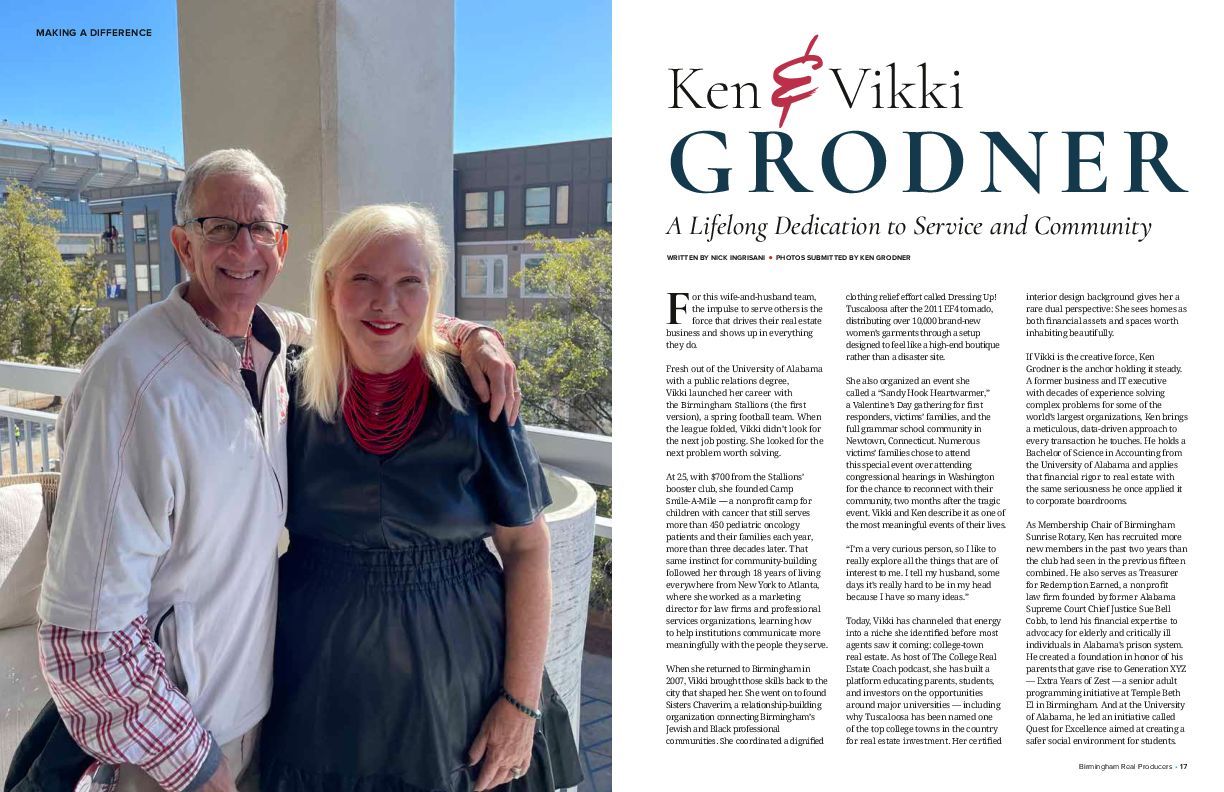
Humbled and Proud to be Featured in Real Producers We're honored to share that Ken and Vikki Grodner were recently featured in Real Producers magazine. The article shares more than their real estate journey. It tells the story of a lifelong commitment to service, community involvement, and the values that continue to shape Hospitality Network Group today. Thank you to our friends, families and clients who continue to trust and support us. We couldn't do this without you. Enjoy the article. – Ken & Vikki Click image to make larger
June 25, 2026
There are some closings that stick with you. Most closings are memorable for the families involved. Every home purchase represents a new chapter. But every once in a while, a story comes along that stays with you long after the paperwork is signed and the keys have changed hands.
By Vikki Grodner April 2, 2026
How parents are using Self-Directed IRAs to invest in real estate near the University of Alabama You’ve done the math, and it’s a tough pill to swallow. Four years of student housing rent in Tuscaloosa can easily exceed $60,000 . By graduation day, that money is gone, and you have nothing to show for it but a stack of receipts. It’s no wonder more University of Alabama parents are asking: What if we bought a property instead? Then comes the hesitation: “I don’t want to tie up all my liquid cash.” What if the solution was already sitting in your retirement account?
By Vikki Grodner April 2, 2026
Recent data shows the average first-time homebuyer is now 40 years old. But here’s the question: Is that because people truly can’t buy sooner — or because they assume they can’t? In this episode of College Real Estate Coach, Vikki Grodner sits down with Royce Dickerson and Ken Grodner of Hospitality Network Group at Keller Williams to challenge one of the biggest myths in real estate today: that young professionals have to wait years before buying a home. The reality? Many are closer than they think.
By Vikki Grodner February 27, 2026
2025 Real Estate Market Insights from KW Family Reunion: What Leading Experts Are Saying About 2026
By Vikki Grodner February 26, 2026
If you have a student heading to the University of Alabama, one of the first major financial decisions you will face is housing. Most families automatically rent. But one family chose a different path. In a recent episode of College Real Estate Coach, Barbara and her granddaughter Virginia shared why their family decided to purchase a townhome in Tuscaloosa instead of signing a lease near campus — and how that decision reframed college housing from an expense into a long-term investment.
By Vikki Grodner December 10, 2025
College-town real estate is one of the strongest, most predictable investment strategies in the U.S. Markets like Tuscaloosa (University of Alabama) and Birmingham (UAB + Samford University) rank among the top places for parents and investors looking for strong returns, steady occupancy, and long-term appreciation. In a recent episode of College Real Estate Coach , host Vikki Grodner interviewed Atlanta real estate expert Michael Hickman about the micro-markets around Georgia Tech, Emory, Georgia State, Spelman, Morehouse, Clark Atlanta, and Kennesaw State. His insights revealed an important truth: Not every college town behaves the same — and knowing the micro-markets is everything. The lessons from Atlanta directly reinforce why Tuscaloosa and Birmingham continue to outperform as investment markets.
By Vikki Grodner September 19, 2025
Turning College Housing Costs Into Wealth: Why More Parents Are Buying Homes A recent Business Insider article highlighted a growing trend: parents are choosing to buy homes in college towns for their students rather than paying room and board or rent. And it’s not hard to see why—what was once a four-year expense is now becoming a pathway to long-term equity and wealth. At Hospitality Network Group at Keller Williams , we’re passionate about helping parents and investors seize these opportunities. College town real estate isn’t just about having a place for your student to live—it’s about transforming a major cost into a smart investment.
By Vikki Grodner August 14, 2025
Tuscaloosa: America’s #1 College Town for Real Estate Investing (and #2 for Short-Term Rentals!) A recent BiggerPockets analysis ranked Tuscaloosa #2 in America for college towns with the best short-term rental opportunities —putting it ahead of nearly every other football destination in the country. And it’s not just short-term rentals making headlines. Tuscaloosa was also recently ranked #1 in the nation for college town real estate investing , making it a rare m arket that delivers strong returns across multiple investment strategies. At The Hospitality Network Group at Keller Williams , we help parents and investors turn these rankings into real results. We know where the highest returns are hiding, what buyers need to know before they invest, and how to structure deals that win big in Tuscaloosa’s thriving market.
By Vikki Grodner July 30, 2025
From student condos to game-day getaways, discover why Auburn’s real estate market is becoming a magnet for parents and investors looking to build wealth in one of the South’s most iconic college towns.